
What Happens When Two Appraisers Give Completely Different Values?
- Laura Cade
- May 6
- 6 min read

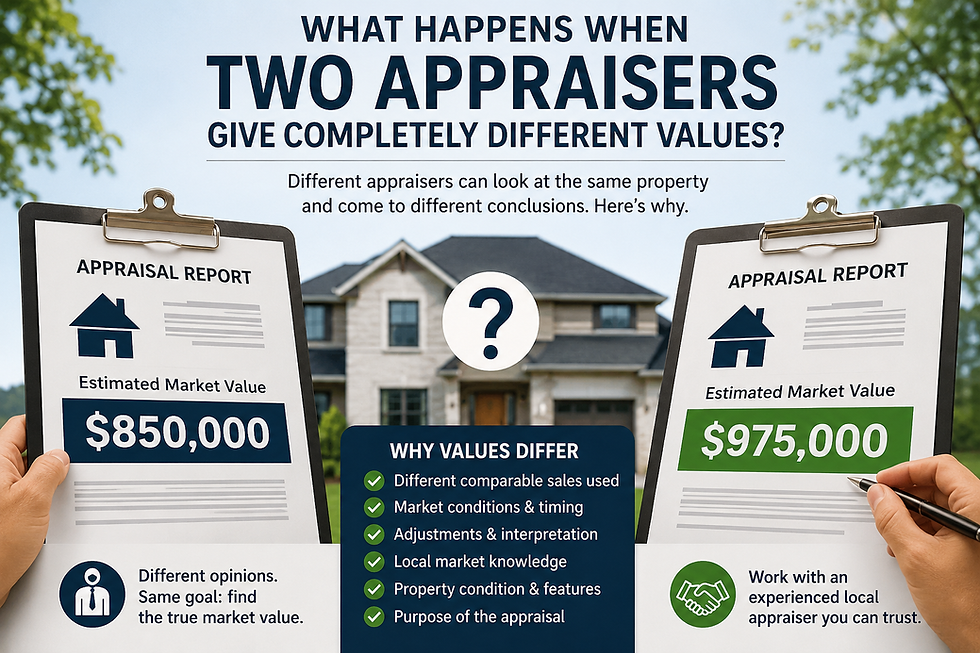
If you have ever received two real estate appraisals with completely different values, you are not alone. This situation happens more often than most people realize and can create major confusion for homeowners, buyers, lenders, lawyers, accountants, and real estate agents.
One appraiser says your property is worth $850,000. Another says it is worth $975,000. How can there be such a large gap when both appraisers are looking at the same property?
The answer is more complicated than most people think.
Real estate appraisal is not simply plugging numbers into a calculator. It involves market analysis, professional judgment, interpretation of data, and selecting comparable sales. Even highly qualified appraisers can sometimes arrive at different conclusions, especially in changing or complex markets like Ontario.
In this article, we will explain why appraisal values can differ, what causes major discrepancies, when differences are reasonable, and what property owners should do if they receive conflicting appraisal reports.
Why Real Estate Appraisals Are Not Exact Science
One of the biggest misconceptions about real estate appraisals is that there is always one “correct” value.
In reality, market value is an opinion of value based on available market evidence as of a specific date.
Professional appraisers follow established standards and methodologies, but there is still room for interpretation. Two experienced appraisers may analyze the same market differently depending on:
• Comparable sales selected
• Market conditions
• Property condition analysis
• Adjustment methods
• Highest and best use interpretation
• Experience level in a specific market
• Intended use of the appraisal
This is especially true in unique or rapidly changing markets.
For example, a standard subdivision home in St. Catharines may be relatively straightforward to appraise. However, a waterfront property in Niagara-on-the-Lake, a hobby farm in Haldimand County, or a mixed-use commercial building in Hamilton may involve far more judgment and interpretation.
The Most Common Reasons Two Appraisers Give Different Values
1. Different Comparable Sales Were Used
The selection of comparable sales is one of the biggest reasons appraisal values differ.
Appraisers attempt to find the most similar recently sold properties available. However, there may not always be perfect comparables.
One appraiser may prioritize:
• More recent sales
• Sales closer in distance
• Similar square footage
• Similar age or design
Another appraiser may place greater emphasis on:
• Superior location
• Lot size
• Renovation quality
• Income potential
In slower or rural markets, finding truly comparable sales can be difficult. One appraiser may expand the search area geographically, while another may expand the search historically to older sales.
This can lead to noticeably different value conclusions.
2. The Market Changed Quickly
In declining or rapidly rising markets, timing matters enormously.
A property appraised in January may have a very different market value by April.
Ontario markets such as Niagara, Hamilton, Burlington, and surrounding areas have experienced periods where prices changed significantly within months. If appraisers interpret market trends differently, the values may vary substantially.
One appraiser may apply:
• Stronger time adjustments
• More conservative market trend analysis
• Different weighting to older sales
In a declining market, this becomes especially important.
For example:
• Appraiser A may believe values declined 1% monthly
• Appraiser B may believe the decline was only 0.25% monthly
That difference alone can create a major value gap.
3. One Appraiser Has Better Local Market Knowledge
Real estate is highly localized.
An appraiser unfamiliar with a specific neighbourhood or rural area may overlook important market influences that a local expert would recognize immediately.
Examples include:
• School district premiums
• Busy road influences
• Proximity to industrial uses
• Seasonal waterfront demand
• Flood risk concerns
• Agricultural influences
• Zoning nuances
• Future development potential
This is why local market experience matters greatly.
A Niagara property should ideally be appraised by someone familiar with Niagara market behaviour, not someone working primarily several hours away.
4. The Property Has Unique Features
Unique properties are much harder to appraise.
Examples include:
• Luxury custom homes
• Large acreages
• Waterfront homes
• Mixed-use properties
• Severed lots
• Properties under construction
• Homes with legal secondary suites
• Heritage properties
• Multi-unit buildings
The more unique the property becomes, the more professional judgment enters the process.
When comparable sales are limited, appraisers may reasonably interpret the market differently.
5. One Report May Be More Conservative
Not all appraisals are completed for the same purpose.
An appraisal prepared for:
• Mortgage financing
• Divorce proceedings
• Estate settlement
• Tax planning
• Litigation
• Private sale decisions
may involve different reporting requirements and risk considerations.
Lenders often prefer conservative interpretations because they are attempting to manage financial risk.
A private appraisal prepared for planning purposes may place different emphasis on marketability or future potential.
6. Adjustments Were Applied Differently
Appraisers make adjustments for differences between the subject property and comparable sales.
Common adjustments include:
• Lot size
• Living area
• Garage count
• Basement finish
• Renovations
• Pools
• Views
• Location
• Age and condition
Adjustment methodology can vary significantly between appraisers.
For example:
One appraiser may adjust:
• $40 per sq ft for size differences
Another may adjust:
• $75 per sq ft
Neither is automatically wrong. Adjustment support depends on local market evidence and professional interpretation.
Are Large Differences Between Appraisals Normal?
Small differences are very common.
For example:
• 3% to 7% variance may be completely reasonable
However, major differences:
• 10%
• 15%
• 20% or more
usually suggest that something significant differs in the analysis.
This does not necessarily mean one appraiser is incompetent.
It may indicate:
• A complex property
• A changing market
• Limited comparable sales
• Different assumptions
• Different intended uses
That said, sometimes one appraisal genuinely is weaker than another.
Signs an Appraisal May Be Less Reliable
Some warning signs include:
Poor Comparable Selection
Using sales from very different neighbourhoods or property types without strong justification.
Outdated Sales Without Proper Time Adjustments
Older sales may distort value if the market changed significantly.
Lack of Local Market Understanding
Ignoring neighbourhood stigma, busy roads, zoning issues, or external influences.
Minimal Commentary
A strong appraisal should explain the reasoning behind adjustments and comparable selection.
Unsupported Adjustments
Adjustments should reflect market evidence and logic, not random figures.
What Should Homeowners Do if They Receive Two Different Appraisals?
1. Compare the Comparable Sales
Look carefully at:
• Location
• Sale dates
• Property style
• Condition
• Lot characteristics
Are the comparables truly similar?
2. Read the Commentary
The best appraisal reports explain:
• Why certain sales were selected
• Why adjustments were made
• Market conditions
• Strengths and weaknesses of each comparable
The reasoning matters just as much as the final number.
3. Consider the Effective Date
Appraisal values are tied to a specific date.
If the market changed between reports, differing values may be completely reasonable.
4. Understand the Purpose of the Appraisal
Mortgage lending appraisals often differ from:
• Estate appraisals
• Litigation appraisals
• Tax planning appraisals
• Market rent studies
Purpose affects methodology and risk tolerance.
5. Ask Questions
A professional appraiser should be willing to explain:
• Comparable selection
• Adjustments
• Market trends
• Methodology
Good communication matters.
Why Automated Online Estimates Often Create More Confusion
Many homeowners compare appraisals to automated online value estimates.
This can be misleading.
Automated valuation models cannot properly account for:
• Interior renovations
• Deferred maintenance
• Layout functionality
• External influences
• Legal issues
• Zoning complications
• Marketability concerns
• Unique features
This is especially true in smaller Ontario markets where sales data is limited.
Professional appraisers physically inspect properties, analyze market trends, and apply human judgment that algorithms cannot fully replicate.
Final Thoughts
Receiving two different appraised values can feel frustrating, but it is not unusual.
Real estate valuation involves professional analysis, market interpretation, and judgment. Different appraisers may legitimately arrive at different conclusions, especially in changing or unique markets.
The key is understanding why the values differ.
A strong appraisal should:
• Use appropriate comparable sales
• Clearly explain adjustments
• Demonstrate local market knowledge
• Reflect current market conditions
• Provide logical and transparent reasoning
When reviewing appraisal reports, focus on the quality of the analysis rather than simply choosing the highest number.
In real estate, the most reliable appraisal is not necessarily the one with the highest value. It is the one best supported by market evidence.
For property owners, lawyers, accountants, lenders, and buyers throughout Niagara, Hamilton, Haldimand, Norfolk, and surrounding Ontario markets, working with an experienced local appraiser can make a significant difference when dealing with complex valuation issues.


Comments